.jpg)
Amy Maxmen -
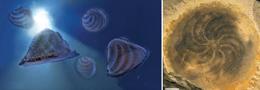
A 580-million-year-old fossil is casting doubt on the established tree of animal life. The invertebrate, named Eoandromeda octobrachiata because its body plan resembles the spiral galaxy Andromeda, suggests that the earliest branches in the tree need to be reordered, say the authors of study in Evolution and Development1.
The researchers, led by paleontologist Feng Tang of the Chinese Academy of Geological Sciences in Beijing, believe that Eoandromeda is the ancient ancestor of modern ocean dwellers known as comb jellies — gelatinous creatures similar to jellyfish, but rounder and with eight rows of iridescent paddles along their sides. If they are right, it would be the oldest known fossil of a comb jelly. And that would support a rewrite of the animal tree. Comb jellies sit alongside two other major groups near the base of the tree, but their relative positions remain contentious. Normally, sponges are identified as the first to evolve, followed by the cnidaria — jellyfish, sea anemones and their kin — and then by the comb jellies." Eoandromeda puts a little piece of weight in favour of a more basal position for comb jellies," says Stefan Bengtson, a palaeontologist at the Swedish Museum of Natural History and a co-author on the paper.That evidence comes from the fossil's shape: it has octoradial symmetry, meaning its body can be sliced into eight identical pieces. This is in stark contrast to modern comb jellies, which, like humans, flies and sea anemones, have biradial or bilateral symmetry — their body plan can be sliced into only two identical pieces.
Posted via http://batavia08.posterous.com batavia08's posterous


No comments:
Post a Comment